Wednesday, October 13, 2010

What to read while proctoring state tests

October is a really tough month at work because my day is spent watching kids fail at the required state tests. Sometimes I'm allowed to read parts of the test to them, but most of the time, I have to sit beside them and (supposedly) cheer them into doing their best on tests that are overwhelming and meaningless to them, but very much a component of what funds my job.

So, yeah, sometimes I read at work.
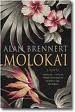
I started reading Alan Brennert's Moloka'i which is a novel about the leper colony on one of the islands that eventually became Hawaii. This was my book club assignment and I was intrigued because it wasn't something I would ever pick up. Confession: I have serious issues with books that have a lot of bodily fluid talk in them. I suppose that makes me a bit of a prude, but there you have it. The only thing I remember about Salman Rushdie's Midnight's Children is that the protagonist had a big nose that was always oozing something or other. So much for a masterpiece. Obviously a book about leprosy was going to be a challenge.

Actually, the oozy bits and sloughed off body parts weren't the problem in this book and I forged ahead. In fact, I almost finished it, but I thought the writing was pretty bad. The author couldn't decide on a point of view so there were vertiginal swoops from one character to another, sometimes within a paragraph. I kept going because the story was definitely intriguing--the life and times of a 7 year old girl sent away to live on Moloka'i when leprosy was considered a dangerous and infectious disease. Parts of this life were fascinating and parts were, frankly, quite dull. After awhile I didn't care anymore. Plus I was stuck in a small, windowless room with kids failing to read the word "mechanical" and so unable to help pass a test that essentially funds my job. I needed something more light-hearted than leprosy.

Fortunately, my office is next to the school library, so between tests, I picked up a copy of Roderick Townley's The Blue Shoe, which is on this year's Great Stone Face Award. The subtitle of The Blue Shoe is A Tale of Thievery, Villainy, Sorcery, and Shoes, and it was fantastic. I read 3/4 of it while "working". I've only read three of the books on this list, but this one's a clear winner. Hap Barlo is a gifted thief, sent to do hard time on a distant mountain full of evil humans and angry blue-faced Auks (dwarf-like characters). He is doing penance for feeding a beggar in his home town--begging being a criminal offense. As the narrator puts it--and it's an intrusive narrator--Did I mention that the poor were arrested in Aplanap? They were. Well, beggars were arrested. You could be poor all you wanted and you'd be left alone. But if hunger forced you into the streets to beg for a coin, large men would come and cart you to jail, and from there, they'd ship you to the north side of the next moutnain, a peak so tall its top was perpetually covered in snow and surrounded by swirling clouds.

Hap doesn't really mind being sent to the mountain, as he hopes to reunite with his formerly-begging father, but it is a bad place. Eventually, aided by the love of his thirteen-year-old life, some Auks and the women who love them, some luck, and some magic, Hap sets things right, while showing up the obnoxious mayor and his wife. The mayor gets a great description. The narrator flatly refuses to say his name--claiming it is unpronounceable--but lovingly describes the scary wart on his brow that helps keep the villagers in line. Imagine what is wife--Ludmilla the Large is like. All the characters are amusing and well-written so that's half the treat. The ending is disappointing, but I guess most kids' books are that way. Definitely The Blue Shoe is a great escape if you're ever stuck doing some mind-numbing work that depresses you to boot.
I like to think I'm inspiring the testing kids to read more and therefore pass the test next year.

In the meantime, I've moved back to the adult world and onto Julia Glass' excellent The Widower's Tale. More on that when testing season is over.

Wednesday, September 29, 2010

The Cellist of Sarajevo

We have famously short-term memories as a culture. This is why political ads work so well. We forget that it was the other guy that put us where we are today. But being stupid about the recent past isn't supposed to apply to me so it was with increasing embarrassment that realized how little I remembered about the Bosnian conflict as I devoured Steven Galloway's excellent book, The Cellist of Sarajevo.

Galloway himself admits his book isn't thoroughly accurate and the reader is left with little information about the conflict or its roots. What he offers instead is a profound look at life in a modern war zone. I had to keep reminding myself that I wasn't reading about WWII and that I had watched some of this on television, in a very recent lifetime.

The book is divided by point of view. We are introduced first to the cellist, a man finally so devastated by the senseless killing around him that he vows to play Albinoni's Adagio in G Minor for 22 days straight at the site of the most recent massacre. Galloway bases this character on a real person so you get a whiff of authenticiy. As the cellist begins his vigil, we are introduced to three other characters-Kenan, a father and husband just trying to get drinkable water to his family (an odyssey in his wartorn city), Dragan, a pensioner, trying to get his daily bread (literally), and Arrow, the sniper recruited by the "defenders" of Sarajevo to take out the "aggressor" snipers targeting civilians throughout the streets. Each chapter begins with one of these characters highlighted while the other names recede into a grey type. I loved this detail, even though it wasn't that difficult to keep the characters apart, a real gift from an author. The visual was just a nice way to begin a chapter.

After months of watching their beloved and beautiful city become ruins--a city hitherto best known for its role in the start of WWI--it comes down to this: Each character daily weighs what might keep him or her alive. If you're dressed as a penguin, is a sniper more or less likely to choose you as target? Kenan contemplates this very thought as he runs with his water canisters strapped to his back, Do the men on the hills tend to shoot at people they find funny, or spare them? If the person who crosses the intersection before you is killed, do you stand a better or worse chance of making it across? What if the sniper misses? Is he having a bad day, or is he playing with you? And, in the Arrow the sniper's case, she wonders, is she a killer or a defender? And what is she defending, exactly? In the end, the character of Dragan phrases it this way: Is the real Sarajevo the one where people were happy, treated each other well, lived without conflict? Or is the real Sarajevo the one he sees today, where people are trying to kill each other, where bullets and bombs fly down from hills and the buildings crumble to the ground?

Author Galloway begs his characters to find and keep their humanity while their lives have become little more than those of scurrying rats. The few animals--dogs mostly--who appear all seem strangely more settled by this new world of danger, while the humans themselves are regressing. The question is, will one cellist's work and stubborness be enough to remind them all of where they've come and who they truly are? And will we the readers pay attention long enough to remember that humanity exists even under the most savage conditions.

Sunday, September 26, 2010

The Imperfectionists

It turns out that if it takes me more than a week to read a (relatively short) book, there's a good chance I'm not enjoying that book. Sadly, that's what's been holding me up. I was stuck reading Talking to Girls about Duran Duran. I thought I would love that. I mean, DURAN DURAN! I wasn't as crazy a fan as friend Heather in junior high, but I had all the posters on the wall and in my locker that my meager allowance offered. Plus, it promised to be a pleasant romp through memory lane of that 80s music that more or less formed me. Turns out, not so much. Just couldn't get into it.

Enough about badness and on to the book that I devoured in two days: Tom Rachman's The Imperfectionists. The story is told by different characters, all working at an international newspaper based in Rome. Each story is a little bit depressing, but it's all set in Rome so you're willing to put up with a bit of dissatisfaction on the part of the characters because you can't beat the gig. That's pretty much how they feel about their lives, too. One character even realizes that the reason he's with his younger, very attractive girlfriend is that he can offer her a nice apartment in Rome in which she can sit around. He says he can't imagine she'd give him the time of day in a cheap apartment in Boston, for example. As difficult as their jobs might (or might not) be, each character seems to realize the luck or the allure of their current positions, even as they angle to do more than say, write obituaries. Each character has a sad little experience or awakening, even if it's not as tragic as the one that befalls the obituary writer, Arthur Gopal, and each story is neatly turns us back to the office.

My favorite character is probably Herman Cohen, partly because his awakening is more positive than some of the others and partly because he's chief copy editor who's internal publication (called Why?) collects all the misspellings and errors made by the writers over the week. I relish that little detail and can relate to it while being grateful that I don't work with such a nitpicker myself.

I did skip one chapter, the one on Winston Cheung, the Cairo stringer, because I could sense it was going to be the sort of chapter that would haunt me, leave me feeling sorry and responsible for this young man's failures. I'm sure it's good, but it's not for me. The revenge chapter towards the end was brutal but kind of fitting, and one I'm sure a lot of randomly down-sized employees could enjoy. I did kind of regret that there wasn't some big bringing together everyone chapter at the end, though there is closure, of sorts. I was just left wanting a little more.

The book is really a collection of glimpses into the slow decline of newspapers in general, but it's a nice little ride. It reminded me a bit of season 5 of HBO' s The Wire, the one that focused on the newspaper in which you got all the personalities, the grasping aspirations of the individual journalists, their realization that they cannot transform lives or their city merely through print, and finally, the end of the newspaper as they know it. That was one of The Wire's strongest seasons, and Tom Rachman's The Imperfectionists, follows a similar path, in a very different manner. And in spite of the negatives, it still made me dream of living abroad and writing for a living. Just maybe with a bit less personal drama and fewer things going wrong.

Wednesday, September 8, 2010

The Information Officer

Apparently I'm reading about small islands in the Mediterranean, specifically during wartime. In the wake of Sadie Jones' Small Wars, I picked up Mark Mills' The Information Officer which taught me a lot about Malta, a country I'm not sure I could have placed with any degree of confidence just a week ago. This is a different war and different place from Smith's Cyprus novel. Also it was a different style and genre.

As if the story of a small island being bombed to bits (in spite of the Maltese and their "indominable spirit") during WWII didn't offer enough drama, Mills drops in a couple of murders, a psychopath, and hints of secret and secretive agents. In some ways I liked that the war was "just" a backdrop to every day matters (such as murder) because it fit along with the image we have of Malta, a country that has apparently resisted one onslaught after another. The Germans are the current attackers in this book, along with the apparently half-hearted Italian neighbors, but it's also (as in Smith's Cyprus) the British presence that is causing some of the trouble.

As in any mystery, I became extremely paranoid about every character, including the protagonist, Max, who is the titular propagandist for the British. He's a nice character and interesting in a dull, heroic way, but no one was safe from my suspicions once "sherry girls" start getting murdered. In a mystery, it can go one of two ways. Either it's the obvious bad guy and it's just a matter of why and how, or it's out in left field, a sort of the-butler-did-it scenario. If you're lucky, the author brings you along for the ride whichever way he or she chooses to go. I wasn't totally satisfied with the killer in The Information Officer. I suppose authors who choose to "surprise" you almost have to write the early chapters as if they have no idea who the killer is, but then it's hard to accept the result. I guess I like hints, though Mills is decent enough at red herrings--as I said, I became suspicious of everyone--but I'm not sure I'm convinced by the results.

Still, The Information Officer was a good glimpse into a country I knew nothing about, a good example of life in wartime, and the writing was good so I'd probably read another book by the author.

Tuesday, August 31, 2010

Small Wars

Sadie Jones' Small Wars is a stealth book. At first, it seems like it's going to be your typical slow-to-build story with lovely writing, kind of a dull plot, but something you'd learn from if you read carefully--a style that could also describe a certain kind of Englishman, really. I didn't always feel like picking it up, but I could never put it down and I ended up loving this story of family life in war-time Cyprus, a time in the 1950s when the British were still trying to hold onto "their" little Mediterranean outpost.

Clara Treherne is a good wife who goes out with her two young girls to join her army major husband in Cyprus, She really is a good wife and tries to be brave and tries to not mind that he's off interrogating the locals for terror connections. She tries to become friends with the other wives even though they are not nearly as good as she is. And her husband is a good, good man, too. Hal is one of those morally upright career soldiers who believes in duty and country without being pedantic or insufferable. He's a good leader of men and believes himself to be a good husband, though he definitely depends on Clara's efforts not to cause a scene or a fuss or to complain or to admit to being scared.

So, these are good people, trying to do what they believe is right and just. It turns out, of course, that there is no good and just in war, particularly not in the guerilla type war that the Greeks and Turks, the Cypriots, are waging against each other and against, especially, the British presence. Bad things happen. Bombs are laid on pristine beaches, old men or boys are beaten for information and women are their usual casualties of war. Things degenerate in a slow but steady slide, leaving Clara and Hal slightly bewildered at how this all could happen, how they could find themselves at such cross purposes from all they believed about their jobs, their country and their love for each other.

There are some fairly brutal and sad scenes, though Jones never makes us feel like voyeurs to a horrific highway accident. Instead we share first Hal's and then Clara's fear or disillusionment. When it all becomes too much, when they are lashing out at one another to avoid admitting to their fear and confusion, Hal finally sends Clara and the children to safety in Damascus. But of course, that turns out to be where danger lies and their world is turned suddenly upside down.

This is not a tragedy in the classic sense. There's no grand and dramatic ending. It's more like life and growing up. Both Hal and Clara have to come to terms with the reality of their roles and to let go of the blind optimism they once held. On a grand scale, it feels a little like the cultural shift from the golden-hued nostalgia of the 1950s to the grungier, earthier 1960s. It's not that the shift is bad in itself, but it's a dramatic change in thought and style of living. So it is with Hal and Clara at the end of Small Wars.

One of the things Sadie Jones does brilliantly is to show us two sides to events. She manages to pull off sympathy for both Clara and Hal (and for various other characters), even while we see how poorly they go about executing their decisions. There's a constant theme of misunderstanding, or at least, misinterpretation of each other's moves. When Hal finds a talisman given to Clara by another soldier, what is he supposed to think? But we know the truth. When Hal sends Clara to Damascus, she feels it is a dismissal because he doesn't want to be with her, that somehow she has failed him, but we've already seen what leads Hal to this heart-wrenching decision. The lack of communication is evidence enough to how bad things have gotten for both of them, and there's some question near the end if they'll ever find themselves or each other again. These are the "small wars" that they're fighting, I suppose, but they all add up to the big one.
I wasn't completely happy with the ending. I really wanted the bad guys to get what they had coming and I wanted the good guys vindicated and treated as heroes. Sadie Jones does it better, though. This is a British book, after all, and not everything is black and white, so the characters are left reshaping their lives to fit the new reality of the day. A beautifully written, unsentimental book about the every day shifts in marriage and the inevitable sadness there is to any kind of war-time life.

Friday, August 27, 2010

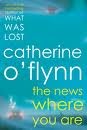
The News Where You Are

I had a really smelly copy of this book which made it hard to get into. Sometimes library copies have obviously been in the home of a smoker, or several smokers, but Catherine O'Flynn's book The News Where You Are smelled like someone had rubbed it up under their armpits and only then had they blown second-hand smoke through its pages.

So, yeah, it was hard to pick up. I was also afraid it would be yet another book about a man having a mid-life crisis, which seems to be the rut I've fallen into for some reason. And yes, it turns out it IS about men having crises--not necessarily mid-life, but certainly about life. It's about vanity and lack of vanity and whether or not we should cling to the past or embrace the future. The story opens with a murder--a hit-and-run--but the mystery behind that is less interesting than you think it's going to be. Our symbol for all that is right or wrong in life is in the form of protagonist Frank Allcroft.

Frank is a local news anchor who has stayed local well past the time most in his profession move on to bigger and better. Frank is happy enough where he is, though contented is more of the word. Or maybe lazy? Or is it stuck? He's not unhappy, in spite of some sad or stumbling events at the moment. His mentor Phil has just been killed in a car accident at the age of 78 and at the same time, Frank's famous father's buildings are slowly being demolished around Birmingham, UK. The juxtaposition of losing his father figure and the architectural link Frank had to the distant father he barely knew would be enough to send anyone into a tailspin. But Frank doesn't really spin. He's too solid in his outlook. His depressive mother does her best to finish him off (mentally), but she's too amusing for him (or us) to really believe she's depressive. His wife wins the award for the least jealous, most supportive wife in literature and so it is his various female co-hosts who are left to express anger and resentment at the slow slide women feel in a profession built on looks and youth. As well as to point out how stupid TV news--with local color! --is becoming.

Frank takes his job very seriously and seems to enjoy it and his life. He answers every letter and email unless they are "outright abusive or threatening" (company policy). One letter, written in all lower case is from someone who claims to have seen him going into a liquor store and then to have followed him to a house of ill repute. The "friend" reminds him that "jesus is watching and so am i."
Frank obviously isn't a shabby, closet drinker who pays for prostitutes when off air. No, Frank is the sort of man who pays for someone else to write really bad jokes that he then bungles on air. This is what Frank is known for (to everyone except the letter writer, obviously). He inherited his joke writer from mentor Phil and felt too kind and obligated not to continue the arrangement, knowing full well that he can't deliver humor the way Phil could. He's earnest in an non-annoying way and he's not much of a trouble maker at all so he's not sure how to answer this particular email.

Frank wondered if he should mention in his reply that he'd never been in that branch of Oddbins. He wondered if that mattered...He thought about the shabby man who had been followed in error. He liked the idea of having a double out there absorbing the sidelong glances and the harmful thought waves. He imagined the man as his tireless protector, his clothes shabby from pounding the city streets 24/7 as Frank, taking the odd drink to fortify himself against the baffling comments people shouted out to him.

This sort of thinking is exactly why he ends up doing PA events for just about anyone who asks, and why he is still happy enough at his job. In some ways, Frank is a refreshing character--someone who is just as he appears to be, without being dull. A tricky balance for a writer to pull off, but I think O'Flynn manages it well.

The mysterious death of Phil was a bit of a let down, but this book never was about Phil anyway.In the end, the important characters come together unexpectedly, Phil's death is resolved, Frank grows up, and all is well in the heart of England.

Saturday, August 14, 2010

The Three Weissmanns of Westport

I'm one of those people who reads Jane Austen as if making a yearly pilgrimmage. I'm devoted to her books, having read Pride and Prejudice something like 10 times, though I'm not nearly as obssessed as some people. I don't, for example, generally pick up books that are continuations of her books, sequels, or books in which the new author has thrown in some superfluous sea monsters or zombies. No, I'm a bit of a purist, but I'll admit I like the predictable romance. Cathleen Schine's The Three Weismanns of Westport is not a predictable romance, but it is a retelling of Sense and Sensibility, molded to fit a modern age, and I thoroughly enjoyed it.

Betty Weissmann and her two middle-aged daughters are exiled to a run-down cottage due to impending divorce and career implosion. Actually one daughter goes along simply to keep an eye on her sister and mother who happily float outside of reality, particularly economic reality. This is the Eleanor character while Miranda plays flighty, romantic Marianne. The matriarch has a much bigger role here than in Austen's book and she's very entertaining, for example as a lady of leisure and wealth discovering infomercials for the first time. Betty had begun watching daytime TV and found it extraordinarily informative and reassuring. There were so many problems in the world she had never though of, and so many products to solve them.


Betty pretty much pretends she's a widow when her husband of 50 years dumps her for a younger woman and she really doesn't have a head for playing poor, though she enjoys her Costco fake fire and the coziness of playing at widowhood, even while she tires of cooking for her grown daughters. Strangely, Betty is more planted in the world, more astute, than flighty Miranda. Miranda's literary Agency has imploded (in a James Frey sort of way, replete with Oprah visit), but she has no concept of money or what to do. When she finds the beach too short for mournful walks in foul weather, she buys herself a kayak in which to storm the seas, so to speak. Never mind that she's never been in a kayak before or that they have no money. How can she deny herself what she knows is so good for her soul?
Annie is the voice of reason, or tries to be, but she's often drowned out by her sister's histrionics and her mother's devotion to both her former husband and her new-found life of "deprivation." Besides, of course, Annie is suffering from her own problems and doesn't feel allowed to express them. She's the solid one, she's the one who pays the bills and expects exactitude, ever tamping down her family's excesses. It's a lonely struggle for all of them, even as they live unexpectedly cheek by jowl.

Men show up eventually, as they do in any good Austen novel. Some of them less appropriate than others, some that you think you can read a mile away (either because you know your Austen or because they're a type), but Schine twists Austen's plot to fit the modern age so that the ending isn't quite the one we expect. The characters and the hangers on are all fun, even the villains. It's especially fun if you know Sense and Sensibility because it was great trying to sort out who was who. If you can't face reading Austen, just rent the Ang Lee movie. Sure, Hugh Grant minces around in a rather strange way that I'm sure I used to find charming, but Emma Thompson and Kate Winslet make up for this, and it's all about the women anyway, isn't it?